





Top Message
A look back at fiscal 2021
For the December 2021 fiscal term, the final year of our previous Medium-Term Management Plan, total net sales increased 25.5% from the previous term to 1,385.9 billion yen thanks to the strong performance of our Overseas Housing and Real Estate Business - in particular, our US housing operations. Recurring income increased 134.2% to 137.8 billion yen and profit attributable to shareholders of the parent company soared 213.0% to 87.2 billion yen, a record high profit that significantly exceeded our forecasts.
In the Timber and Building Materials Business, despite a tight supply and soaring prices of timber worldwide, sales and profits of imported lumber products, imported plywood and domestic lumber grew. In the Housing and Construction Business, thanks to successful digital marketing efforts of our main custom-built detached housing business, orders received and the ratio of ZEH (net-zero energy houses) rose, which combined with an increase in unit sales prices and new housing starts, resulted in higher net sales. However, rising wood and other building material costs held down profits.
The Overseas Housing and Real Estate Business, which drove our performance, registered significant increases in both sales and profit thanks to a strong new housing market in the United States, increases in the number of units sold and per unit prices, and robust real estate development operations. Through M&As and investments these past several years, we have been actively positioning ourselves in a growth market that is expanding both in terms of scale and diversity. As a result, we have been able to capitalize on this booming market to steadily lead the increase in overall Group revenues.
The Environment and Resources Business benefited from the strong performance of our overseas forestry business in New Zealand and Indonesia as well as rising timber prices in our domestic forestry business. In addition, the start of operations of the Kanda Biomass Power Plant and our other wood biomass power generation plants contributed to profits.
In our Lifestyle Service Business, the two elderly-care facility companies continued operations throughout the COVID-19 pandemic thanks to thorough preventive measures. We also opened the VISON Hotel in Taki, Mie Prefecture, in July 2021.
Despite the COVID-19 pandemic, we were able to respond flexibly to changes in our operating environment to register record high profits for each of the three years* of our previous Medium-Term Management Plan. In terms of sales, profit and all major financial indices, we significantly exceeded forecasts.
* The December 2020 fiscal term was nine months due to a change in the fiscal year, and we achieved record high third quarter profits.
Formulating our long-term vision
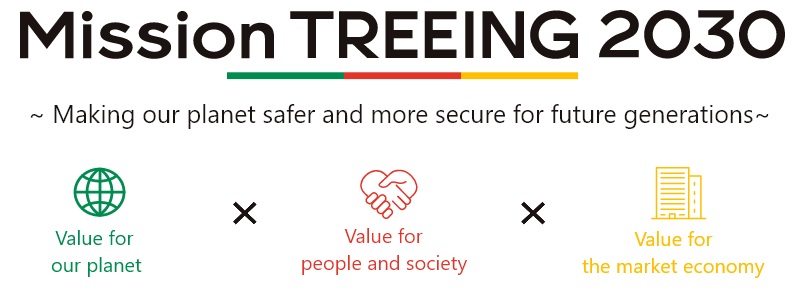
The world is facing an uncertain post-COVID future with Russia's invasion of Ukraine, decarbonization efforts and numerous other factors. It is precisely during times like these that the Sumitomo Forestry Group must continue to contribute to resolving societal issues and realizing a sustainable society through our business activities. By providing value for our planet, for people and society, and for the market economy, we want to make our planet safer and more secure for current and future generations of people and all living beings.
In preparation for 2030, the target year of our SDGs, we have formulated Mission TREEING 2030, our long-term vision that sets out what type of company we want to be. In drawing up this long-term vision, we surveyed our customers, business partners, investors, Group employees and other stakeholders from both within and outside the Company. In addition to incorporating their hopes and expectations for the Sumitomo Forestry Group, we held repeated internal discussions with mixed groups of employees, both young and management level. Through these processes, we were able to identify three values we want to provide - value for our planet, value for people and society, and value for the market economy. We are committed to promoting business activities that simultaneously enhance all three values without sacrificing any of the other values.
Business policy
-
1 Maximizing the value of forests and
wood to realize decarbonization
and a circular bioeconomy2 Advancing globalization
-
3 Striving for transformation and
the creation of new value4 Transforming our business
foundation for growth
Based on these discussions, we also developed four different themes for Mission TREEING 2030: 1) Maximizing the value of forests and wood to realize decarbonization and a circular bioeconomy; 2) Advancing globalization; 3) Striving for transformation and the creation of new value; and 4) Transforming our business foundation for growth.
For our first theme, maximizing the value of forests and wood to realize decarbonization and a circular bioeconomy, our Group's business operations both in Japan and overseas are pursuing the capacity of wood resources to absorb and reduce CO2 and contribute to the realization of a decarbonized society. For our second theme, advancing globalization, we are further expanding our overseas operations with the United States, Australia and Asia as our core overseas business platforms. For our third theme, striving for transformation and the creation of new value, we are promoting digitalization and other forms of business innovation and rebuilding the revenue base of our main businesses in Japan to restore profitability. For our fourth theme, transforming our business foundation for growth, we are working to hire, nurture and retain talented people who can respond to the increasing globalization and diversification of our operating environment. We are also enhancing employee engagement and reinforcing our risk management systems.
Through these and other initiatives, Sumitomo Forestry Group will strive to contribute to the decarbonization of society and expand to have a Group recurring income of 250 billion yen by 2030.
Contributing to the realization of a decarbonized society
One of the business policies of our long-term vision is maximizing the value of forests and wood to realize decarbonization and a circular bioeconomy. To achieve this, we are going beyond decarbonization initiatives and setting goals that not only provide economic value, but also appropriately protect precious natural resources, such as biodiversity and water. Trees absorb carbon dioxide from the atmosphere in the growth process of photosynthesis, and even after harvesting, store large amounts of carbon.
Utilizing wood for high-quality housing, furniture and other uses stores carbon for long periods of time and is the concept of HWP (harvested wood products) outlined in the Kyoto Protocol. In October 2021, the Forestry Agency released guidelines for construction and other companies on how to calculate carbon fixation amounts. By planting trees after logging, the younger trees more effectively absorb and store carbon as they grow. In addition, wooden buildings have significantly lower CO2 emissions compared to steel frame or concrete buildings. Construction waste from building demolitions, unutilized wood from woodlands, and sawdust and wood chips from manufacturing facilities can be utilized for biomass power generation as an alternative to fossil fuels, further reducing CO2 emissions. This cycle of harvesting trees, replanting them and then utilizing the wood they produce can make a significant contribution to realizing a decarbonized society.
For our long-term vision, we are pursuing initiatives in three fields - forests, wood and construction. In the area of forests, we have established a forestry fund to increase the sustainable forest area we own or manage worldwide from the current approximate 280,000 ha to 500,000 ha. In addition to forest management for sustainable timber production, we want to create high-quality carbon credits by appropriately maintaining and managing natural forests and tropical peatlands. Establishing this type of circular forestry business will support decarbonization for both countries and companies.
In the field of wood, we are promoting higher domestic self-sufficiency and greater use of wood, what we call wood change. To manage the growing stock of forests in Japan, we are establishing timber industrial complexes that fully utilize domestic wood using the cascade method, from wood product manufacturing to fuel for biomass power generation. As a first step, we have begun the operation of a wood processing plant in Shibushi, Kagoshima Prefecture.
In the field of construction, we are working to visualize CO2 emission reduction amounts and standardize decarbonized design. Specifically, we will implement an environmental labeling system called EPD (environmental product declaration) for building materials and equipment.
We will also establish a design method that visualizes a building's life cycle CO2 emissions using One Click LCA, a software that enables life cycle assessment calculations related to construction. The construction sector accounts for almost 40% of the world's CO2 emissions. Of this, 70% is operational carbon (CO2 during occupancy), which is the CO2 from energy usage in houses and offices. We are working to reduce operational carbon with the popularization of renewable energies, ZEH (net-zero energy houses) and ZEB (net-zero energy buildings). The remaining 30%, called embodied carbon (CO2 during construction), is the CO2 from the raw material procurement, processing, transport, construction, repair and disposal of building materials. With an increase in construction in developing countries and other parts of the world, reducing embodied carbon will become a critical issue. As the efforts of any one company alone would be insufficient, the construction industry as a whole must advance initiatives to reduce CO2 emissions, such as promoting the visualization of CO2 emissions for each building material and method. Our Company is promoting the standardization of decarbonized design by acquiring EPD for the construction industry and popularizing One Click LCA.
Ever since our establishment in 1691, our Company has been involved in a wide variety of businesses both in Japan and overseas centered on wood. With the ongoing operation of the wood cycle where trees are nurtured, utilized and then replanted, we believe we can contribute to decarbonization and resource recycling for not only our own Company, but for society as a whole.
Our new Medium-Term Management Plan
Our new Medium-Term Management Plan, which started in fiscal 2022, is positioned as Mission TREEING 2030 Phase 1, part of our long-term vision. During this time frame, we will create the foundation for future growth and decarbonization. In our previous Medium-Term Management Plan, we were able to significantly expand our Overseas Housing and Real Estate Business, a major pillar of earnings, and enhance the competitiveness of materials, labor and other costs. For our new Medium-Term Management Plan, we will recover the profitability of our domestic operations, which was a remaining issue in our previous Medium-Term Management Plan. In addition, we will invest in our Resources and Environment Business, which forms the core of our decarbonization efforts, and strengthen the foundation needed to realize our long-term vision. In the Timber and Building Materials Business, we will build processing plants as a first step to creating timber industrial complexes that better utilize domestic timber. In addition, we will actively invest in decarbonization, DX promotion and other new businesses that have the potential to become a pillar of our operations. In the Housing and Construction Business, we will promote digital marketing and rationalization of construction methods to further increase the competitiveness and market share of our custom-built detached housing business. We will also expand our spec home business, our non-residential building business and renovation business. In the Environment and Resources Business, we will actively expand the area of forest land we manage both in Japan and overseas.
The further growth of our Overseas Housing and Real Estate Business
The further growth of our core Overseas Housing and Real Estate Business is a critical factor in achieving our Medium-Term Management Plan targets. In our main US market, rising policy interest rates are driving higher mortgage rates, which is resulting in declining affordability.
However, demand for housing is expected to remain strong for the mid- to long-term due to an increase in the first home-buying population, such as Millennials, Generation Z and other demographic groups, and a housing shortage of four to six million units. Our Group is developing properties in regions with above-average population growth. Of the top 10 cities building the most new homes, we have a presence in eight. Furthermore, these cities have a lower-than-average home-price-to-income ratio, which gives us reason to believe that the market will continue to grow.
In addition to the United States, our Group considers Australia and ASEAN countries to be important markets where the population and economy are expected to grow steadily in a post-COVID era. By carefully selecting land plots and developing products that match the area's characteristics, we plan to increase the number of single-family homes we sell to 20,000 units per year. In addition, with the expansion of our detached rental housing business, we are broadening our business field and at the same time, enhancing our cost competitiveness through better rationalization of materials and construction to build a business structure that can secure stable profits in any type of operating environment. To realize decarbonization through the construction of wooden buildings, which have a low environmental impact, we are also developing midand large-scale non-residential wooden building operations in the United States, Australia, the United Kingdom and other countries.
A resilient organization that works with a diverse range of stakeholders
Sumitomo Forestry Group is undertaking a number of initiatives to grow and transform into a resilient organization that values diversity. As part of management's commitment to sustainable growth, our director compensation system is now linked with ESG management indices and specific long-term CO2 emissions reduction targets. To ensure that employees from a diverse range of backgrounds can work with a sense of security and harness their individuality, we introduced a new financial-performance-linked evaluation system that better promotes goal achievement and employee growth. In October 2021, we also announced our Declaration of Health Management to promote workstyle reform.
To work with a diverse group of stakeholders, we must actively pursue alliances, join organizations and pay close attention to emerging sentiment while sharing our own company's knowledge, technologies and future vision. To begin fully promoting the understanding and utilization of biodiversity and other natural assets, we became a member of the Taskforce on Nature-related Financial Disclosures (TNFD). Compared to a year ago, interest in embodied carbon reduction and decarbonization through forest utilization has grown. More than ever before, we are meeting with business partners and new companies we have had no past contact with about opportunities for collaboration.
To our stakeholders
The Sumitomo Business Spirit is an integral element of our corporate philosophy and within it, there is the phrase, "Benefit self and benefit others, private and public interests are one and the same." Behind this is the conviction that Sumitomo's business must benefit the nation and society and emphasize harmony with public interest, and the belief that companies are simultaneously both private entities and public institutions. By revitalizing forests and popularizing wooden construction, we want to contribute to the decarbonization of the world. This is our 21st century interpretation of benefiting self and benefiting others. As we work tirelessly to pursue these goals, we kindly ask our stakeholders for their ongoing understanding and support.
Toshiro Mitsuyoshi
President and Representative Director
Toshiro Mitsuyoshi
President and Representative Director
